
Experiment to measure sound velocity at 0°C using a resonance tube, tuning forks, and an air column, accounting for end correction for accurate results.
Apparatus
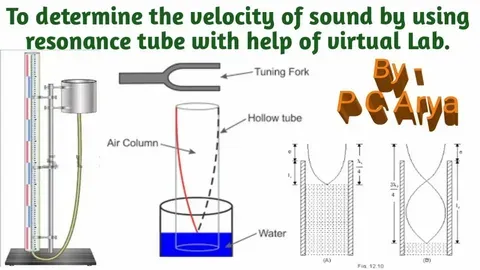
Resonance tube apparatus, pinch cock, vernier callipers, thermometer, two tuning forks of known frequencies, a rubber pad, a set square, and a beaker.
Each component serves a purpose. For instance, the tuning forks produce sound waves of known frequency, while the resonance tube helps identify the air column length at resonance. Moreover, the thermometer measures the temperature needed for later calculations.
Observations
-
Room temperature at the beginning = t₁ °C
-
Room temperature at the end = t₂ °C
-
Mean Room Temperature = t = (t₁ + t₂) / 2 = … °C
-
Position of the open end of the tube against the scale = X = … cm
|
No. of obs |
f Hz |
First resonance position level |
L1= A-X |
Second resonance | L2=B-X | l = l2-l1 cm | ||||
| Falling A1 |
Rising A2 |
Mean ‘A’ | Falling |
Rising |
Mean ‘B’ | |||||
| cm | cm | Cm | cm | Cm | cm | |||||
|
1 2 |
||||||||||
|
1 2 |
||||||||||
Calculations
To find the velocity of sound, first determine the length of the air column at resonance. Then, use the formulas below:
V1t=2f1lcm/sV_{1t} = 2 f_1 l \quad \text{cm/s} V2t=2f2lcm/sV_{2t} = 2 f_2 l \quad \text{cm/s}
Next, calculate the mean velocity at temperature t °C:
Vt=V1t+V2t2=…cm/sV_t = \frac{V_{1t} + V_{2t}}{2} = … \text{cm/s}
Afterward, the velocity of sound at 0°C is obtained using:
V0=Vt−6t=…cm/sV_0 = V_t – 6t = … \text{cm/s}
Finally, compare this with the actual value and determine the percentage error.
Procedure
-
First, place the resonance tube horizontally on a stable surface.
-
Then, check its level with a plumb line and adjust it using the foot screws.
-
After that, note the initial water temperature using a thermometer.
-
Record the position of the upper end of the resonance tube as X.
-
Next, raise the water reservoir and gently open the pinch cock.
-
Strike a tuning fork (for example, 512 Hz) on a rubber pad and hold it horizontally above the tube’s open end.
-
Gradually lower the water level until a loud sound is heard — this marks the first resonance.
-
Moreover, use a set square to note this level accurately.
-
Continue lowering the water to find the second resonance position.
-
Then, measure the air column length between both resonance points.
-
Repeat the same steps with another tuning fork.
-
Finally, record the final temperature and calculate the velocity of sound at 0°C.
Viva Voce Questions and Answers
Q1. What is resonance?
Resonance refers to a marked increase in amplitude when a body vibrates under a periodic force that matches its natural frequency.
Q2. What types of waves are produced in the resonance tube?
Longitudinal stationary waves are produced in the air column of the tube.
Q3. What is the effect of pressure on sound velocity?
In gases like air, pressure has almost no effect on the velocity of sound.
Q4. What is the effect of temperature on sound velocity?
As the temperature increases, so does the velocity of sound. For every 1°C rise, velocity increases by approximately 61 cm/s.
Q5. What is end correction?
The antinode forms slightly above the open end. This shift requires an adjustment called end correction, equal to 0.3D, where D is the internal diameter of the tube.
Q6. What role does water play in the resonance tube?
Water helps adjust the air column’s length and provides a reflecting surface for sound waves. Furthermore, it helps control resonance levels.
Q7. What is wave motion?
Wave motion is a disturbance that travels through a medium due to periodic vibrations of its particles.
Q8. Differentiate between transverse and longitudinal waves.
In transverse waves, particles vibrate perpendicular to the wave’s direction. However, in longitudinal waves, particles vibrate parallel to it.
Q9. How do water vapours affect sound velocity?
Water vapour reduces air density, and consequently, the velocity of sound increases.
Q10. How does temperature affect sound velocity?
A rise in temperature increases molecular energy, which results in a higher sound velocity.
Q11. How does density affect the velocity of sound?
Velocity is inversely proportional to the square root of the medium’s density. Hence, sound travels more slowly in denser media.
Q12. What are stationary waves?
When two identical waves move in opposite directions and overlap, they form stationary waves that appear to stand still.
Q13. Where are nodes and antinodes formed?
A node forms at the closed end (water surface), while an antinode forms slightly above the open end.
Q14. Why is the antinode slightly above the open end?
This happens because of diffraction — the spreading of sound waves as they exit the tube.
Q15. On which factors does sound production depend?
Sound production depends on two factors: a vibrating body and a material medium that carries the sound.
Q16. Does the frequency of sound change when it enters another medium?
No. Frequency remains constant, although wavelength and velocity change.
Q17. Why is water used in the tube?
Water allows variation in the air column length and provides a node surface at its level.
Q18. How are waves reflected?
When a wave passes from a rare to a dense medium, it reflects with a 180° phase change. Conversely, reflection from a dense to a rare medium occurs without a phase change.
Q19. Does sound velocity change with frequency?
No, velocity in a given medium remains the same for all frequencies.
Q20. Why do we hear a loud sound at resonance?
At resonance, the amplitude of vibrations increases, and since loudness depends on amplitude, the sound appears louder.
Q21. Why should the tuning fork be struck near its end?
Striking near the end minimizes the formation of overtones and ensures a pure note.
Q22. Does changing the tube diameter affect sound velocity?
No. Sound velocity depends on the nature of the medium, not the tube’s diameter.
Q23. Why are two tuning forks used?
Using two tuning forks confirms that sound velocity stays nearly constant for different frequencies.
Q24. Why must the resonance tube remain vertical?
Keeping the tube vertical prevents distortion in the water surface and ensures accurate measurement of the air column.