
🚀 A Revolutionary Step in Space Exploration
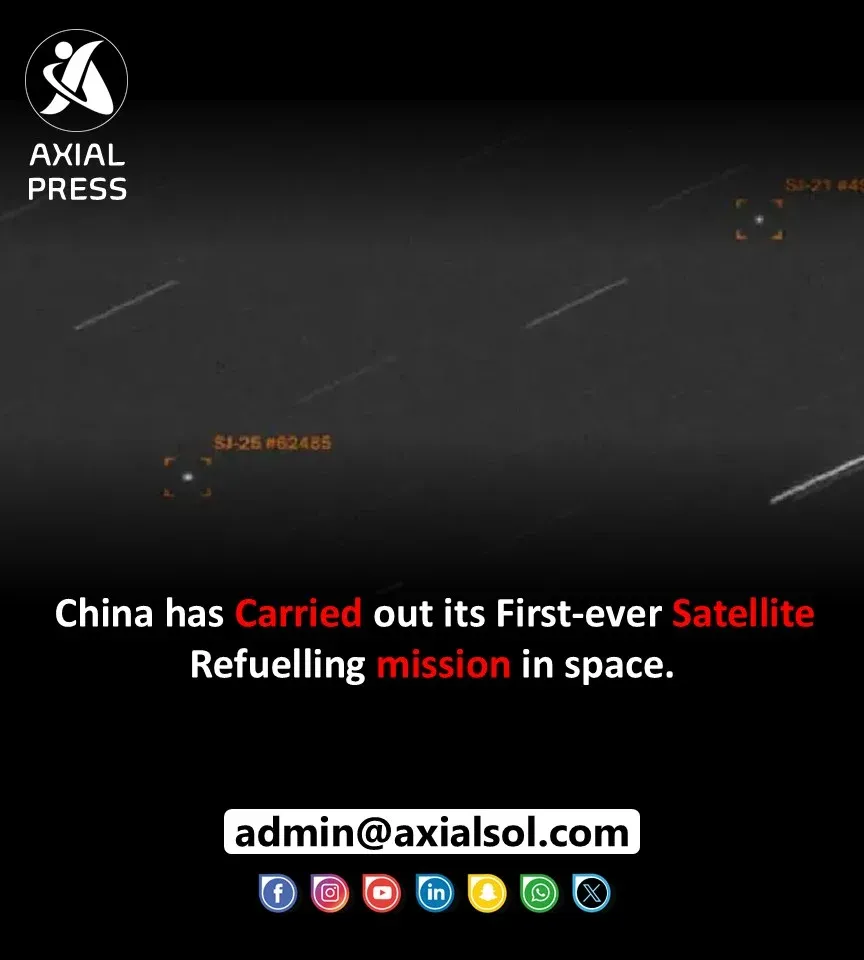
China has achieved a remarkable milestone by completing its first in-orbit satellite refueling mission. This success highlights the nation’s growing strength in advanced space technology. The mission, observed by two American satellite tracking companies, shows that China’s spacecraft may have refueled another satellite while orbiting the Earth. Experts around the world have hailed this as a revolutionary breakthrough that could transform the way satellites operate in the future.
🛰️ The Satellites Behind the Mission
Tracking reports show that China’s Shijian-25 (SJ-25) satellite moved close to another satellite, Shijian-21 (SJ-21). The two spacecraft came extremely close to each other, suggesting that a refueling test was carried out in orbit. The American company Slingshot Aerospace also confirmed that it had observed the same movement through its satellite monitoring systems.
If this refueling is officially confirmed, it will mark the world’s first successful in-orbit refueling operation. This would allow satellites to stay functional for longer periods, saving costs and reducing the need to launch replacements.
🔭 How Scientists Observed the Mission
The docking process was observed from Earth using powerful telescopes. Because the observation was made from the ground, scientists have not yet confirmed every detail of the refueling maneuver.
According to a report by Space News on June 6, both Shijian-21 and Shijian-25 were spotted in geosynchronous orbit, roughly 22,236 miles (35,786 kilometers) above the equator.
Observers noted that on June 14, the two satellites came very close again, performing what appeared to be docking and undocking maneuvers. These movements were likely part of a test to examine how safely satellites can connect and refuel each other in orbit.
🌌 Why the Mission Matters
The main goal of this test was to evaluate the possibility of refueling satellites in orbit. Successful in-orbit refueling can greatly extend the lifespan of satellites and make future missions more sustainable. It also helps reduce space debris, a growing concern for all spacefaring nations.
If this technology becomes reliable, space agencies could perform repairs, upgrades, and fuel top-ups without sending new satellites into space. This would lower mission costs and improve long-term space management.
🛰️ A History of the Shijian Satellites
China’s Shijian-25 satellite was launched in January 2025. Its purpose is to demonstrate satellite servicing, maintenance, and refueling in orbit. Meanwhile, Shijian-21, launched in 2021, was designed to remove old or malfunctioning satellites by pushing them into a “space graveyard” orbit.
Together, these satellites show China’s vision for creating a self-sustaining space ecosystem, where satellites can repair or refuel one another, reducing dependence on new launches.
🌍 China’s Growing Space Ambitions
China’s space program has rapidly advanced in recent years. It has built a permanent space station, launched lunar missions, and now, with this new technology, it has entered the next stage of sustainable space operations.
Experts believe that this achievement could encourage other countries to invest in similar systems. The ability to refuel satellites in orbit may become a standard part of space missions within the next decade.
🚀 A Step Toward the Future
This mission marks more than just a technological success. It symbolizes China’s determination to lead in the new era of global space exploration. With every new launch, China moves closer to creating a sustainable and efficient space network, one that can support long-term operations around Earth, the Moon, and beyond.