Experiment with Vernier calipers to measure the length and diameter of a cylinder, apply zero error correction, and calculate its volume accurately.
Apparatus
-
Vernier calipers
-
Solid cylinder
Diagram:
Point to Ponder
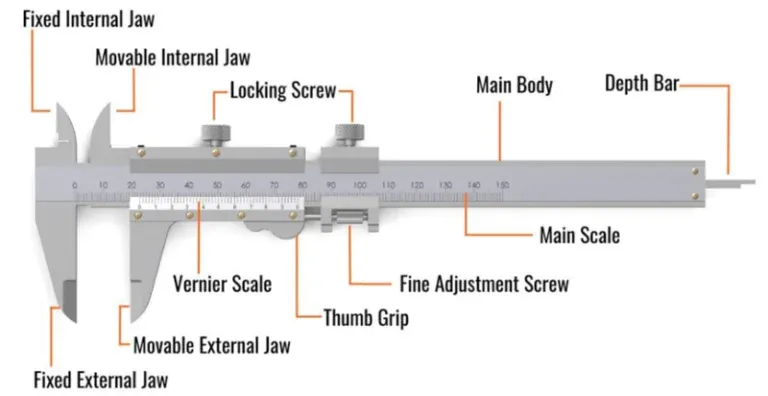
Vernier calipers accurately measure lengths and diameters up to 10 mm. They consist of a rectangular steel bar, called the main scale, graduated in inches on one edge and in centimeters on the other. A smaller scale, the Vernier scale, slides over the main scale.
The caliper has two jaws:
-
Upper jaws measure the internal diameters of tubes.
-
Lower jaws measure external diameters of rods, tubes, and similar objects.
A thin rectangular rod at the back measures the depth of vessels.
Vernier Constant
The Vernier constant (L.C.) equals the difference between one main scale division and one Vernier scale division. When the zero lines of both scales coincide, the zero error is zero. Otherwise, the caliper has a zero error, which can be positive or negative.
Positive Error:
If the zero line of the Vernier scale lies to the right of the main scale zero, the error is positive. Multiply the number of coinciding divisions by the least count to find the zero error.
Example:
-
4th division coincides → Zero error = +4 × 0.01 cm = +0.04 cm
-
Zero correction = -0.04 cm
Negative Error:
If the Vernier zero lies left of the main scale zero, the error is negative. Multiply (10 − coinciding divisions) by the least count.
Example:
-
4 divisions coincide → Zero error = -(10 − 4) × 0.01 = -0.06 cm
-
Zero correction = +0.06 cm
Procedure
-
Determine the least count of the Vernier caliper and check for zero error.
-
Place the cylinder between the lower jaws and tighten the screw.
-
Read the main scale division just to the left of the Vernier zero (R).
-
Find which Vernier division coincides with the main scale (n). Multiply by the least count (y) and add to R:
Observed length=R+y\text{Observed length} = R + y
-
Apply zero correction to get the corrected length.
-
Similarly, measure the diameter and calculate the radius (r = d/2).
-
Finally, calculate the volume:
V=πr2lV = \pi r^2 l
Observations and Calculations
For the calculation of length
Length:
| No.of Obs | Main scale reading R |
No. of Vernier scale div. Coinciding with any main Scale division (n) |
Fraction to be Added Y = n L.C. |
Observed Length = y + R | Corrected Length Z.C |
| cm | div. | cm | cm | cm | |
| 1 2 3 4 |
Mean length of cylinder = l = ……… cm
Diameter:
| No.of Obs | Main scale reading R |
No. of Vernier scale div. Coinciding with any main Scale division n |
Fraction to be Added Y = n L.C. |
Observed Length = y + R |
Corrected Length Z.C |
| cm | div. | cm | cm | cm | |
| 1 2 3 4 |
Mean diameter of cylinder = d = ……… cm
Radius of cylinder = r = d/2 = ……. cm.
Volume of cylinder = V = πr2l = ……..cm³.
The volume of cylinder = V = ……..cm3.
(1) Find the volume of a test tube by using Vernier Callipers.
(2) Find the volume of a solid sphere by using Vernier Callipers.
Precautions
-
Do not press the jaws too tightly.
-
Tighten the screw before taking readings.
-
Apply zero error corrections.
Viva Voce
Q1. What is the Vernier constant (L.C.)?
Ans: The smallest measurement that a Vernier caliper can read.
Q2. What are the parts of a Vernier caliper?
Ans:
-
Upper jaws: measure internal diameters
-
Lower jaws: measure external diameters
-
Depth gauge: measures the depth of vessels
Q3. What is the advantage of Vernier calipers over a regular scale?
Ans: Vernier calipers can measure accurately up to 0.01 cm, unlike a regular scale that measures only in millimeters.