
Experiment to find the wire area or sphere volume using a micrometer screw gauge with pitch, least count, and zero error correction.
Apparatus
-
Micrometer screw gauge
-
Wire or metallic sphere
Diagram
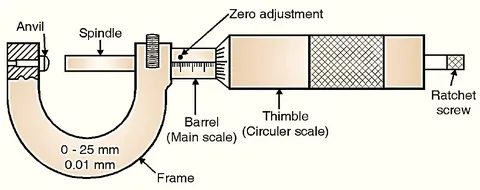
Introduction
The micrometer screw gauge is used to measure the thickness of very thin metal strips or the diameter of a sphere. It works on the principle of a screw. The instrument has a U-shaped frame, a fixed end, and a movable spindle with uniform grooves.
The cylinder has a linear scale marked in millimeters and a circular scale with 50–100 divisions. The circular scale measures fractions of a revolution. The linear scale shows the number of full revolutions. The reading of the circular scale is noted against a reference line.
The device can measure up to 0.01 mm, which is why it is also called a micrometer.
Important Concepts
Pitch
The pitch is the distance the screw advances in one complete rotation.
Zero Error
When the spindle and the anvil touch, the zero error is determined by the alignment of the circular scale with the index line.
Positive Zero Error
If the zero line lies below the index line, the error is positive:
Zero Error=+(No. of divisions)×L.C.\text{Zero Error} = + (\text{No. of divisions}) \times \text{L.C.}
Negative Zero Error
If the zero line lies above the index line, the error is negative:
Zero Error=−(No. of divisions)×L.C.\text{Zero Error} = – (\text{No. of divisions}) \times \text{L.C.}
Procedure
-
Determine the pitch and least count of the screw gauge.
-
Measure the zero error if present.
-
Place the wire between the spindle and anvil. Turn the screw until the wire is gently pressed.
-
Record the linear scale reading RR and the number of circular divisions coinciding with the index line nn. Multiply nn by the least count to get yy.
-
Add yy to RR and apply zero correction to find the corrected diameter.
-
Repeat at three different points of the wire. Calculate the radius r=d/2r = d/2 and the cross-sectional area A=πr2A = \pi r^2.
-
For the sphere, measure the diameter, calculate the radius, and then compute the volume using V=43πr3V = \frac{4}{3} \pi r^3.
Observations and Calculations
= 0.5 mm/ 50
= 0.01mm
Diameter of wire
| No.of Obs | Linear scale reading R |
Circular scale reading n |
Fraction to be Added Y = n L.C. |
Observed diameter = R + y |
Corrected Length Z.C |
| mm | div. | mm | mm | mm | |
|
1 2 3 4 |
Mean diameter = d = ………… mm
Radius of wire = r = d/2 = …….. mm
Area of cross-section of wire = A = π r3 = ……. mm2
Result:
Area of cross-section of wire =A = ……. mm2
| No.of Obs | Linear scale reading R |
Circular scale reading n |
Fraction to be Added Y = n L.C. |
Observed diameter = R + y |
Corrected Length Z.C |
| mm | div. | mm | mm | mm | |
|
1 2 3 4 |
Mean diameter = d = ………… mm
Radius of sphere = r = d / 2 = …….. mm
Volume of sphere = V = 4 / 3 r3 = ……. mm3
Result:
Volume of sphere = V = ……. mm3
Precautions
-
Apply zero error correction in all readings.
-
Do not overtighten the screw.
-
Always turn the screw in the same direction.
-
Ensure the instrument is clean before use.
Viva Voce
Q1: What is the pitch of a screw gauge?
Ans: The pitch is the distance the spindle advances in one full rotation of the circular scale.
Q2: What is a screw gauge?
Ans: It is an instrument used to measure diameters or thickness accurately.
Q3: Calculate the least count if the circular scale has 100 divisions.
Ans:
LC=PitchNo. of divisions=1 mm100=0.01 mm\text{LC} = \frac{\text{Pitch}}{\text{No. of divisions}} = \frac{1 \text{ mm}}{100} = 0.01 \text{ mm}