
Experiment to study the variation of photoelectric current with light intensity using a photocell, galvanometer, and lamp, verifying the inverse square law of l, light.
Apparatus
Photocell, sensitive galvanometer, battery, rheostat, key, electric bulb (preferably a point-type lamp), suitable case for the bulb and photocell, and connecting wires.
Theory
Light intensity is the amount of energy falling per second on a unit area placed perpendicular to the light beam. It is measured in watts per square meter (W/m²).
According to the inverse square law, the intensity of light from a point source decreases with the square of the distance from the source.
Thus,
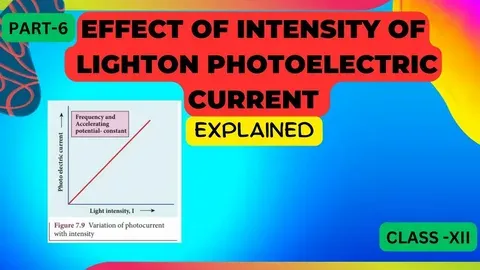
A photoelectric cell contains a photosensitive cathode and an anode enclosed in a glass tube. When light of suitable frequency strikes the cathode, electrons are emitted. These electrons move toward the anode, producing a photoelectric current.
As the distance between the light source and the photocell increases, the light intensity decreases. Consequently, the photoelectric current also decreases, following the inverse square law.
Procedure
-
First, draw the circuit diagram as shown in Fig. 15(a).
-
Next, clean the ends of the connecting wires and arrange the apparatus.
-
Connect the photocell in series with the galvanometer, rheostat, battery (B), and key (K). Ensure the positive terminal of the battery is connected to the anode of the photocell.
-
Then, move the lamp as far away from the photocell as possible.
-
Insert the plug key and adjust the rheostat until a measurable galvanometer deflection is observed.
-
Record the deflection and measure the distance (d) between the lamp and the photocell.
-
Repeat the readings by gradually decreasing the distance in equal steps.
-
For each reading, calculate 1d2\frac{1}{d^2}.
-
Finally, plot a graph between galvanometer deflection (θ) and 1d2\frac{1}{d^2}, taking 1d2\frac{1}{d^2} along the x-axis. The graph should be a straight line.
Observation and Calculation
| NO. OF Obs. |
Distance of the lamp from the photocell deflection cm) | proportional to o.fAsGalvanometer | Intensitthe y of light1/d2(cm2) |
| 1 2 3 4 5 6 |
Conclusion
The graph between galvanometer deflection and 1d2\frac{1}{d^2} is a straight line.
Hence, deflection is directly proportional to 1d2\frac{1}{d^2}, proving that the photoelectric current is proportional to the light intensity.
Therefore, the inverse square law of light is verified.
Precautions
-
All connections must be tight and clean.
-
The anode of the photocell should be connected to the positive terminal of the battery, and the cathode to the negative terminal.
-
A point source of light should be used.
-
The experiment should begin with the lamp placed farthest from the photocell and then moved closer step by step.
Viva Voce
Q1: What is the photoelectric effect?
A: It is the emission of electrons from a material when light of suitable frequency falls on it.
Q2: What is the threshold frequency?
A: It is the minimum frequency of light that can cause the emission of electrons from a material.
Q3: What is the work function?
A: The minimum energy required to remove an electron from a material is called its work function.
Q4: What is a photoelectric cell?
A: It is a device that converts light energy into electrical energy using the photoelectric effect.
Q5: What is a photon?
A: A photon is a tiny packet or quantum of light energy.
Q6: Write the equation for the energy of a photon.
A:
E=hfE = hf
where h is Planck’s constant and f is the frequency of light.