
Study of Geiger-Muller tube characteristics using a radioactive source, scaler, and voltage variation to measure count rate, threshold, and Geiger plateau.
Apparatus
-
Geiger-Muller Tube (Mullard MX 180)
-
Tube holder and connecting leads
-
Universal castle
-
Co-60 radioactive source with lifting tools
-
Time scaler and stopwatch
Theory
The Geiger-Muller tube is a discharge tube containing a cylindrical cathode made of thin metal and a tungsten wire anode stretched along its axis. The tube is filled with inert gas, such as argon, at low pressure and contains a trace of alcohol to quench the discharge.
When a suitable voltage (above threshold but below continuous discharge level) is applied, any charged particle or photon entering the tube ionizes the gas molecules. These ions accelerate, producing secondary ionizations, which cause an avalanche of charge carriers. Consequently, a short electric pulse is generated across an external resistor. Each pulse corresponds to one detected particle and is counted by a scaler.
As the voltage increases, the count rate also rises until it becomes nearly constant. The region where the count rate remains stable is known as the Geiger plateau, and the starting point of this region is the Geiger threshold. However, if the voltage exceeds the plateau limit, the count rate increases rapidly, which may damage the tube.
Procedure
-
Set up the apparatus as shown in the diagram. Place the radioactive source under the GM tube.
-
Switch on the scaler and allow it to warm up for about 5 minutes.
-
Gradually increase the voltage until counts appear on the scaler. Record the voltage and number of counts in 2 minutes, then calculate the count rate (counts per minute).
-
Increase the voltage in small steps (5 V) until the Geiger threshold is reached. Then increase in 20 V steps until the count rate rises sharply. Stop immediately to avoid damaging the tube.
-
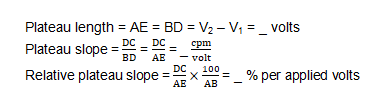
Plot the graph of count rate vs. applied voltage to determine the Geiger threshold, plateau, and relative plateau slope (RPS).
Observations and Calculations
Observation & Calculation:
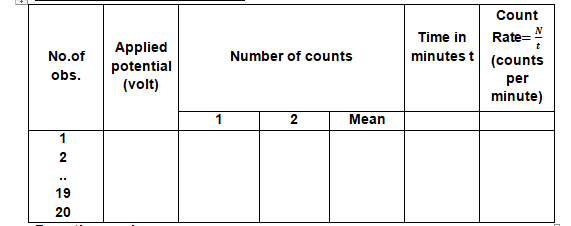
From the graph:
Geiger threshold voltage = OA = _ volts
Precautions
-
Handle the radioactive source carefully using proper lifting tools.
-
Ensure all electrical connections are tight to prevent false counts.
-
Stop increasing the voltage immediately once the count rate increases sharply.
Viva Voce Questions
Q1. What is a Geiger-Muller counter?
Ans: It is a device used to detect and count charged particles and photons.
Q2. What are the characteristics of a GM counter?
Ans: The characteristics are represented by a graph between applied voltage and the number of counts per minute.
Q3. Define the Geiger threshold and Geiger plateau.
Ans: The Geiger threshold is the voltage above which the count rate becomes almost independent of applied voltage. The plateau is the nearly horizontal region of the graph.
Q4. What is quenching?
Ans: Quenching eliminates secondary discharges after detection. It can be external (using high resistance) or self-quenching (using argon and alcohol mixture).
Q5. What is a scaler?
Ans: A scaler is a device that records the number of pulses or counts detected by the GM tube.