
Determining sodium light wavelength using Newton’s Rings setup with a plano-convex lens, glass plate, microscope, calculations, precautions, and viva.
Apparatus
The experiment requires a Newton’s Ring apparatus, a plano-convex lens, a convex lens, a screen with a hole, a sodium light source, a traveling microscope, and a spherometer.
Each component plays a vital role in producing and analyzing the interference pattern. Therefore, all instruments should be properly aligned before starting the experiment.
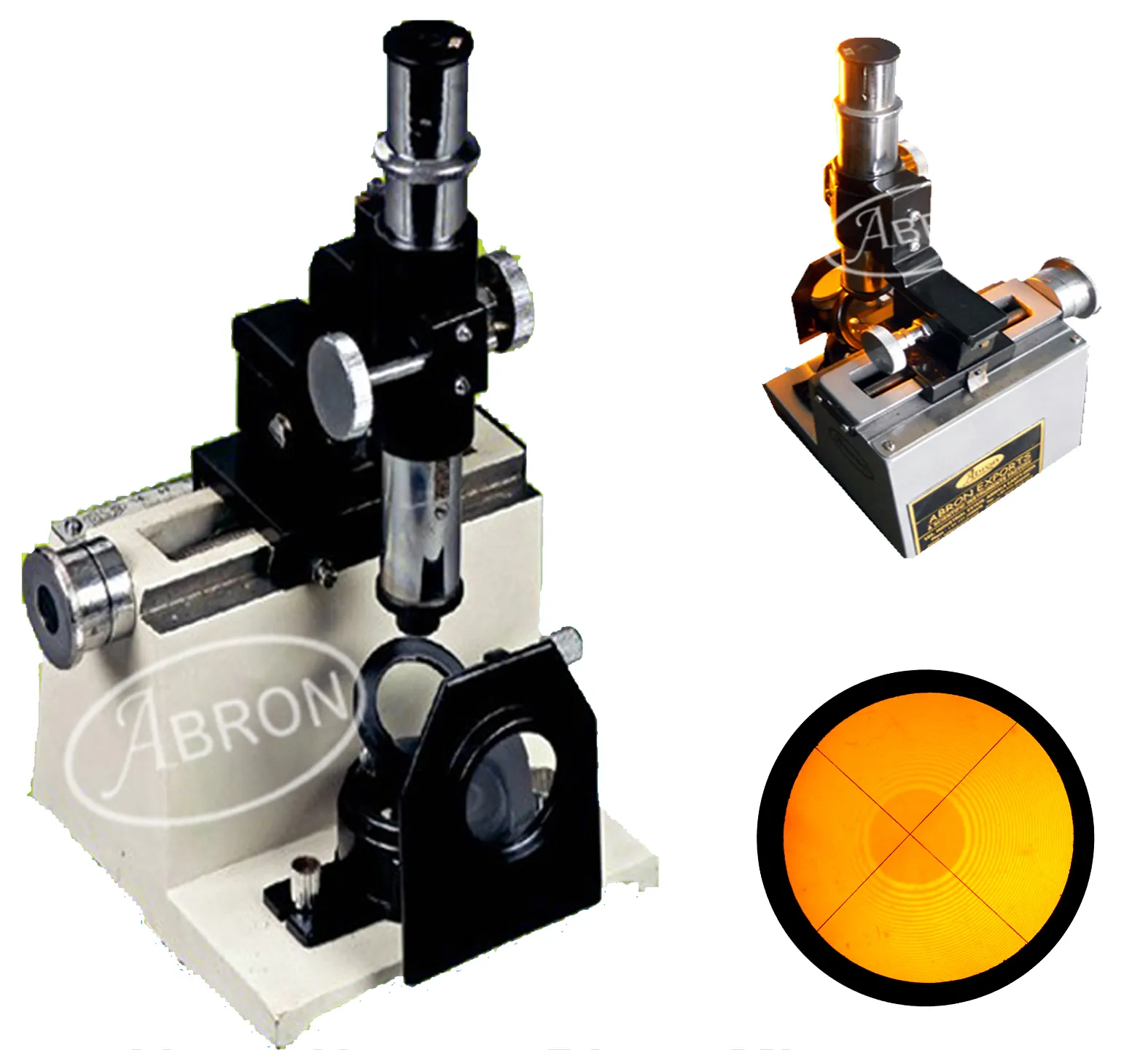
Observations and Calculations
Determination of the Radius of Curvature of the Lens
-
Pitch of the spherometer screw = _______
-
Number of divisions on the circular scale (N) = _______
-
Least count of spherometer = Pitch / N
Furthermore, measure the distance between the three legs of the spherometer: (i) _______ (ii) _______ (iii) _______
| No of Obs | Reading of | spherometer on | Meanh | Radius of curvature |
||
| Convex surface | Place surface | Difference h | ||||
| 123 | ||||||
- Microscope Readings:
Least count of microscope = smallest scale division =___________cm
Number of divisions on the circular scale
| No. ofObs | Ring No. | Reading of RingM | Reading of RingN | |
||||||
| n | m | Left end | Right end | Diameter R Dm | Left end | Right end | DiameterR Da | |||
| 123 | ||||||||||
Result
Hence, the wavelength of sodium light (λ) = ______ Å
Procedure
Firstly, take a plano-convex lens (L), an optical glass plate (G), and a convex lens of small focal length (Li). Clean all surfaces carefully using spirit to remove dust and smudges. Next, arrange the apparatus as shown in the diagram for proper alignment.
Then, fix the convex lens Li into the hole and place the sodium light source at its focus to obtain parallel rays. Meanwhile, set the glass plate G at an angle of 45° and adjust its position so that the light from Li fully illuminates it.
Afterward, place the plate P below G on white paper to prevent unwanted reflections. Subsequently, position the plano-convex lens (L) on plate P so that the contact point O lies directly under the microscope.
Now, mount the microscope vertically above G and focus its eyepiece on the cross-wire. Adjust it carefully until it lies exactly above the center of the lens. As a result, alternate dark and bright circular rings will become visible through the microscope.
Next, set the intersection of the cross-wires at the center of the ring pattern. Because the first few rings are often unclear, focus on the 20th dark ring for accuracy. Then, move the microscope horizontally until the cross-wire touches the ring tangentially and note the reading. After that, repeat the measurement on the opposite side of the same ring to find its diameter.
Similarly, measure the diameters of the 16th, 12th, 8th, and 4th dark rings. Finally, calculate the wavelength of sodium light using the formula:
λ=(Dn2−Dm2)4R(n−m)λ = \frac{(D_n^2 – D_m^2)}{4R(n – m)}
Here, DD = diameter of rings, nn and mm = ring numbers, and RR = radius of curvature obtained from the spherometer readings.
Precautions
-
Firstly, ensure the number of rings remains within the microscope’s field of view.
-
Moreover, use a lens with a large focal length for clearer ring formation.
-
In addition, the sodium light source should be positioned at the principal focus of Li to produce parallel rays.
-
Also, confirm that the cross-wire intersection coincides exactly with the center of the ring system.
-
Furthermore, the light must fall normally on the lens L.
-
The microscope, therefore, should be sharply focused on the point of contact.
-
Lastly, measure the radius of curvature of the surface in contact with the glass plate accurately.
Viva Voce Questions
Q1. What are Newton’s rings?
Ans: The thin film of air between the lens and the glass plate produces circular interference fringes or rings due to repeated reflections from both surfaces.
Q2. What makes a piece of glass visible in water?
Ans: The difference in their refractive indices makes the glass visible.
Q3. What is the interference of light?
Ans: When two coherent light sources emit waves with a constant phase difference, they reinforce or cancel each other, producing bright and dark fringes. This phenomenon is called interference.
Q4. What type of fringes appear when white light is used?
Ans: Coloured circular fringes are observed.
Q5. Why is sodium light used in this experiment?
Ans: Because it is nearly monochromatic, which provides sharp and distinct fringes.