
Experiment to study how photoelectric current varies with light intensity using a photocell, lamp, galvanometer, and battery, based on the photoelectric effect.
Apparatus
Photocell, battery, key, micro-ammeter or galvanometer, electric lamp, ruler, and connecting wires.
Theory
A photocell makes an electric current when light falls on it.
It has two main parts:
-
A cathode that gives out electrons when light shines on it.
-
An anode that attracts those electrons.
When light hits the cathode, it releases electrons. These move toward the anode and create a small electric current. If the light becomes brighter, more electrons move, and the current increases. This shows that the photoelectric current depends on light intensity.
Procedure
-
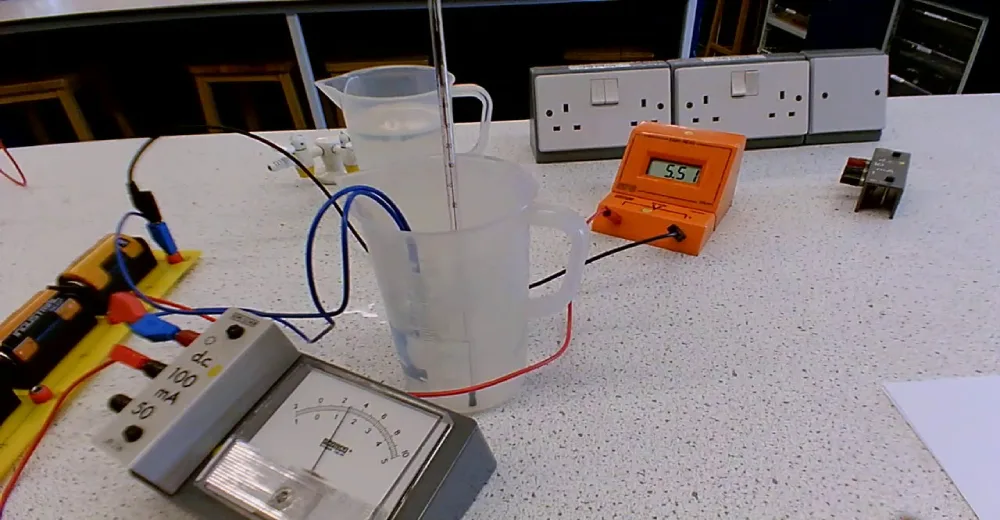
Set up the apparatus as shown in the figure.
-
Keep the lamp 80 cm away from the photocell and note the galvanometer reading.
-
Move the lamp closer step by step — to 70 cm, 60 cm, 50 cm, and so on.
-
Note the galvanometer reading each time.
-
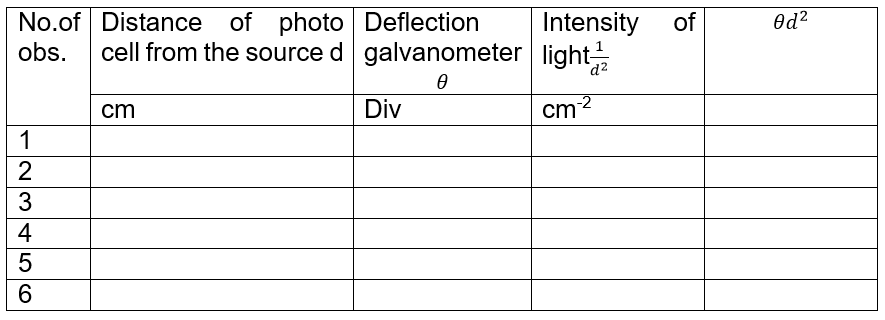
Record all values in a table and draw a graph between current (I) and 1/d² (inverse of the distance squared).
-
You will get a straight line, showing a direct relationship.
Observations and Calculations
Result
The graph between I and 1/d² is a straight line.
Therefore, the photoelectric current increases when the light intensity increases.
Precautions
-
Do not apply more voltage than the rated value of the photocell.
-
Use a sensitive meter because the current is very small.
-
Change the distance of the lamp in equal steps.
-
Use a single-point light source to follow the inverse square law.
Viva Voce
Q1: What is the photoelectric effect?
Ans: It is when light of the right frequency hits a metal surface and makes it release electrons.
Q2: What are photoelectrons?
Ans: The electrons that come out from the metal when light shines on it.
Q3: What happens if the light intensity increases?
Ans: The photoelectric current also increases.