
Determine the refractive index of a liquid using a concave mirror by measuring parallax positions with and without liquid, with the procedure and precautions.
Apparatus
Use a concave mirror of long focal length, a vertical stand with a clamp, a plumb line or parallax needle, a meter rod, an index needle, some water (as liquid), and a wooden stand.
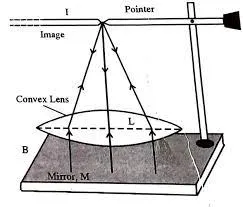
Observations
Approximate focal length of the concave mirror = ………… cm
| No.ofObs. | Distance between the pole of the mirror and the tip of the needle in the parallax position | Refractive index |
|||
| Without liquid | AP | With liquid | A′P | ||
| 1234 | |||||
Mean refractive Index ==…………….
Procedure
-
First, find the approximate focal length of the concave mirror as done earlier.
-
Next, place the mirror on a flat wooden stand. Keep its principal axis vertical.
-
Then, clamp the parallax needle horizontally above the mirror at nearly the focal length.
-
After that, move your eye sideways and adjust the needle until its tip and the inverted image move together. This step removes parallax. At this point, the needle lies at the center of curvature of the mirror.
-
Now, use a meter rod and plumb line to measure the distance AP between the tip of the needle and the pole of the mirror.
-
Next, pour a few drops of water to form a thin, even layer over the mirror. The parallax position will shift.
-
Lower the needle slowly and adjust it until parallax disappears again. This gives the new distance A′P.
-
Finally, repeat the experiment at least three times, calculate the refractive index for each observation, and find the mean value.
Formula
Refractive Index=APA′P\text{Refractive Index} = \frac{AP}{A′P}
Precautions
-
Keep the parallax needle well illuminated.
-
Make sure the mirror surface remains horizontal.
-
Use only a small amount of water to get a thin, uniform layer.
-
Measure all distances carefully to avoid error.
-
Always use a concave mirror with a long focal length.
Viva Questions and Answers
Q1. What is parallax?
Ans: Parallax is the apparent shift between the image and the object when the observer moves their eye.
Q2. What is the radius of curvature of a spherical mirror?
Ans: It is the radius of the sphere of which the mirror forms a part.
Q3. Why should a concave mirror with a large radius of curvature be used?
Ans: It helps reduce measurement errors and supports the required mathematical approximations.
Q4. What is an optically denser medium?
Ans: A medium in which light travels more slowly than in air is called an optically denser medium.
Q5. Where does the image appear when parallax is removed with water?
Ans: The image appears at the center of curvature because the light rays retrace their paths after reflection and refraction.
Q6. What happens if very little water is used?
Ans: The water surface will not stay flat, and image distortion will occur.
Q7. Why are distances measured up to the water surface for both positions?
Ans: For small angles, sine and tangent values are nearly equal, so measuring up to the water surface gives correct results.
Q8. What kind of mirror is best for this experiment?
Ans: A concave mirror with a large focal length gives accurate results.