
Measure DC and AC voltage using a cathode ray oscilloscope; explain sensitivity, procedure, precautions, and calculation of RMS and peak values.
Apparatus
Cathode ray oscilloscope, DC voltmeter, AC voltmeter, step-down transformer, battery, rheostat, key, and connecting wires.
Theory
The voltage required to produce one small division of light spot deflection on the oscilloscope screen is called sensitivity.
When the oscilloscope is switched on, a light spot appears on the screen (with the time base turned off). The spot can be centered using Y-shift and X-shift knobs.
If a known DC voltage is applied to the vertical input terminals, the light spot moves by a certain number of small divisions. The ratio V/NV/N gives the sensitivity S of the oscilloscope.
Next, apply an unknown DC voltage to the vertical input terminals and measure the shift of the spot. The value of V can be calculated using the known sensitivity.
When a known AC voltage is applied to the vertical input terminals (and the time base is off), a vertical line appears on the screen. The length of this line is proportional to twice the peak value of the AC voltage.
The relationship is given as:
Vp=1.41×VrmsV_p = 1.41 \times V_{rms}Procedure
Part 1 – Determining Sensitivity (DC Voltage)
-
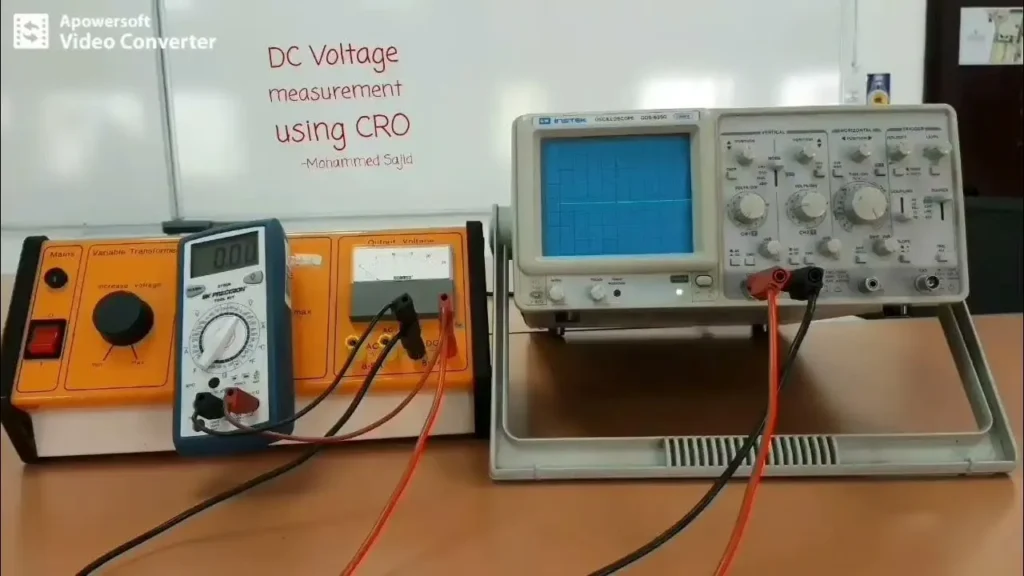
Clean all connecting wire ends and arrange the apparatus as shown in Fig. 17(a).
-
Switch on the oscilloscope and center the light spot using the Y-shift and X-shift knobs.
-
Apply a known DC voltage through the voltmeter.
-
Adjust the potential divider to produce a vertical deflection equal to N small divisions.
-
Note the voltmeter reading V′V’. Then, calculate sensitivity using:
S=V′/NS = V’/N -
Repeat for different values of DC voltage and find the mean value of S.
Next, connect the unknown DC voltage to the oscilloscope and observe the deflection of the light spot. The unknown voltage V is then calculated using the value of S.
Part 2 – Determining AC Voltage
-
Arrange the circuit as shown in Fig. 17(b).
-
Connect the transformer output to the oscilloscope input terminals.
-
Switch on the AC mains. A vertical line will appear on the screen.
-
Bring the line to the center and measure its length L′L’.
-
The length corresponds to twice the peak or RMS value of the known AC voltage.
-
Record the AC voltmeter reading Vrms′V’_{rms}.
-
Replace the known AC voltage with the unknown AC voltage and measure its line length, LL.
-
Calculate the RMS value of the unknown voltage using:
Vrms=(L/L′)×Vrms′V_{rms} = (L/L’) \times V’_{rms} -
Then, calculate the peak value using:
Vp=1.41×VrmsV_p = 1.41 \times V_{rms}
Observations and Results
Mean Sensitivity (S) = ……………
Deflection with Unknown DC Voltage (θ) = ……………
Unknown DC Voltage (V) = …………… Volt
Known AC Voltage (V′rms) = …………… Volt
Length with Known AC (L′) = …………… Divisions
Length with Unknown AC (L) = …………… Divisions
Unknown RMS Voltage (Vrms) = …………… Volt
Peak Value (Vp) = 1.41 × Vrms = …………… Volt
Precautions
-
Ensure all connections are clean and tight.
-
The light spot should be fine and clearly visible.
-
Deflection readings must be in whole numbers.
-
Avoid disturbing the shift knob settings during readings.
Viva Voce
Q1. What is a Cathode Ray Oscilloscope?
A cathode ray oscilloscope (CRO) is an electronic instrument that displays the relation between two or more variables on a fluorescent screen.
Q2. What is the difference between DC and AC?
DC flows in one direction with constant strength, whereas AC changes periodically in strength and direction.
Q3. Define Impedance.
Impedance is the total opposition offered by a circuit to the flow of alternating current.
Q4. What is an Electron Gun?
An electron gun is a group of electrodes that produces a fine beam of electrons in a CRO or similar device.