
The sonometer experiment verifies string laws: frequency varies inversely with length, increases with tension, and decreases with mass per unit length.
-
Verify the law of length.
-
Verify the law of tension (F ∝ T).
-
Verify the law of mass.
Apparatus
-
Sonometer
-
Wires of different diameters
-
Wedges
-
Slotted weight set
-
L-shaped permanent magnet
-
10-watt bulb
-
Power amplifier
-
Audio frequency signal generator
Procedure for the Law of Length
-
Place the sonometer on a table with the pulley at the edge. Stretch a thin steel wire (34–36 SWG) with a 1.0 kg load.
-
Fix the U-shaped magnet at the midpoint using plasticine so that the wire passes between its poles.
-
Adjust the wedges so that the wire length between them is about 70–80 cm. Record this length. Place a paper rider at the midpoint of the wire.
-
Connect the output terminals of the power amplifier to the two ends of the wire with a bulb in series.
-
Connect the amplifier input to the audio frequency generator, and connect it to the main AC supply.
-
Slowly increase the generator frequency until the paper rider falls. Note the resonance frequency.
-
Repeat the procedure for different wire lengths.
-
Plot a graph of frequency vs. 1/length. It should form a straight line.
Procedure for the Law of Tension
-
Set the signal generator frequency to 10 Hz. Reduce the mass to 0.5 kg so that the wire tension is 4.7 N.
-
Slowly increase the frequency until the rider flies off. Record the frequency.
-
Increase the mass, replace the rider, and increase the frequency again until resonance occurs.
-
Repeat for several masses to record tension vs. frequency.
| No. of Obs | Mass stretched | Tension(T) | Frequency of Resonance | F2 | F2 /T |
| 1 2 3 |
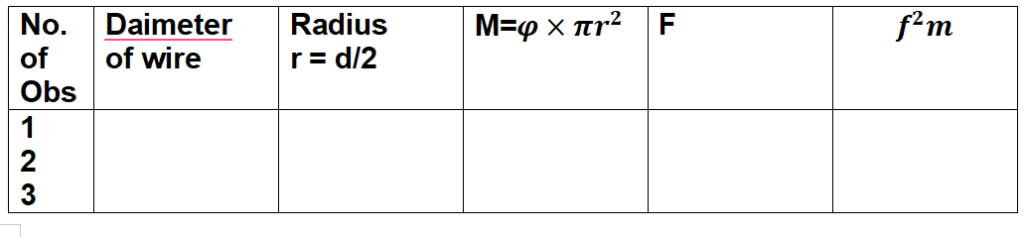
Procedure of the law of mass:
Same set is used for this experiment only by changing the wire of a different diameter, keeping the distance between the wedges sa
Precautions
-
Always place the paper rider at the wire midpoint when moving the bridge.
-
Ensure the wire is straight and kink-free with a uniform cross-section.
-
Use sharp-edged bridges.
-
Keep the U-shaped magnet fixed firmly.
Viva-Voce
Q1. What is a sonometer?
A: It is an instrument with a long hollow wooden box over which a wire is stretched.
Q2. Why is it also called a monochord?
A: Because it consists of a single wire.
Q3. What kind of waves are produced along the wire?
A: Transverse stationary waves.
Q4. What types of vibrations are set up in the wire?
A: Forced vibrations.
Q5. Why does the paper rider fly off at resonance?
A: An antinode forms at the midpoint, where the amplitude is maximum. The rider flies off due to maximum vibration.
Q6. What is the function of a monochord?
A: To determine the unknown frequency of a tuning fork.
Q7. Why is the sonometer box hollow?
A: To amplify the sound of the vibrating wire.
Q8. What are beats?
A: The rise and fall of sound when two frequencies are nearly equal.
Q9. Are sound waves transverse?
A: No, sound waves are longitudinal.
Q10. Wavelength of a single loop on a string?
A: Distance between two consecutive nodes = L or 2L, depending on the loop.
Q11. Law of Length:
Frequency is inversely proportional to string length.
Q12. Law of Mass:
Frequency is inversely proportional to the square root of mass per unit length.