
Determine the focal length of a convex lens using the displacement method by measuring object-image distances and applying parallax correction for accuracy.
Apparatus
A convex lens, three uprights, an optical bench, two parallax needles, a knitting needle, and a meter rod.
Observations and Calculations
-
Approximate focal length of convex lens (f) = …………..m
-
Length of knitting needle (L) = …………..cm
-
Observed distance between object and image needle (L₁) = …………..cm
-
Index correction (L₁ – L₂) = …………..cm
|
No. of obs. |
Position of | Distance between two needles ‘x’ | Position of the lens | d = L2-L1 | f = (x2-d2)/4x cm | |||
| Object needle “O” cm | Image needle ‘I’ cm | Observed cm | Corrected cm | 1st position L1 cm | 2nd position L2 cm | |||
| 1 2 3 |
||||||||
Procedure (Step 1: Initial Setup)
First, determine the approximate focal length of the convex lens by obtaining a sharp image of a distant object on a paper screen or wall.
Then, place the convex lens in its upright holder and mount it on the optical bench along with the needles.
Furthermore, measure the length of the knitting needle using the meter rod. Assign the object and image needles as O and I, respectively.
The distance between the two needles should be more than four times the approximate focal length.
Step 2: Taking Observations
Next, adjust the lens so that the object needle is placed at about 1.5f and the image needle at about 2.5f from the lens.
After alignment, carefully remove the parallax and note the upright positions of the lens and needles. This gives the observed readings.
Then, apply the index correction to obtain accurate measurements.
Afterward, shift the lens to its second position (L₂) and again remove the parallax. Note the new lens position.
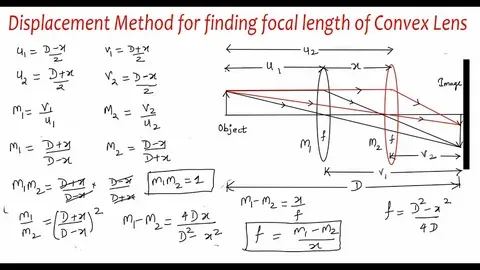
The displacement (d) of the lens is given by the difference (L₂ – L₁).
Step 3: Repetition and Calculation
For accuracy, increase the needle distance by 2–3 cm and repeat the process at least three times.
Consequently, record all readings and apply the formula:
f = (x² – d²) / 4x
Finally, compute the mean focal length of the convex lens for reliable results.
Precautions
-
The distance between the two needles should always be greater than four times the focal length.
-
To avoid eye strain, remove parallax while looking from a distance.
-
Keep the object and image needle positions fixed; only move the lens between two positions.
-
Ensure that all readings are taken carefully to minimize experimental errors.
Viva Voce
Q1. Define a lens.
Ans: A lens is a transparent piece of material bounded by one or two spherical surfaces.
Q2. What is the principal focus of a convex lens?
Ans: It is the point where parallel rays converge after refraction.
Q3. What is the principal axis?
Ans: The line that passes through the optical center and principal focus.
Q4. Define focal length.
Ans: The distance from the optical center to the principal focus.
Q5. How do you differentiate between convex and concave lenses?
Ans: A convex lens is thicker at the center, whereas a concave lens is thinner at the center.
Q6. What is parallax?
Ans: It is the apparent shift in position of an object when the observer changes position.
Q7. What is the optical center?
Ans: A point in a lens where a ray passes through undeviated.
Q8. Distinguish between real and virtual images.
Ans: Real images can be formed on a screen; virtual images cannot.
Q9. What kind of images do convex and concave lenses form?
Ans: A convex lens forms a real image (except when the object is within the focal length), while a concave lens always forms a virtual image.
Q10. What is index correction?
Ans: It is the difference between actual and apparent distances between two points on the uprights.
Q11. What are the main defects of a lens?
Ans: (i) Spherical aberration (ii) Chromatic aberration.
Q12. Why should the needle distance exceed 4f?
Ans: Because the minimum distance between an object and its real image is 4f.
Q13. Define the power of a lens.
Ans: Power = 1 / focal length (in meters).
Q14. What is the unit of lens power?
Ans: Diopter (D).
Q15. Where is the image formed when the object is placed:
(a) at the principal focus → at infinity
(b) at 2F → at 2F
(c) between F and 2F → beyond 2F
Q16. Why is parallax not removed over the full lens aperture?
Ans: Because of spherical aberration.
Q17. Why is the focal length of a convex lens positive and that of a concave lens negative?
Ans: Convex lenses converge rays to a real focus, while concave lenses diverge them.
Q18. What are conjugate foci?
Ans: Two interchangeable positions of object and image that yield the same result.
Q19. What image types do concave and convex lenses form?
Ans: A convex lens forms a real image (except within its focal length); a concave lens always forms a virtual image.
Q20. What is the minimum distance between an object and its real image?
Ans: It is 4f, four times the focal length.
Q21. How does light bend when moving:
(a) from denser to rarer medium → away from normal
(b) from rarer to denser medium → towards normal