
Experiment to convert a galvanometer into an ammeter of 0–1.5A range by connecting a suitable shunt resistance in parallel and verifying through calculations.
Apparatus
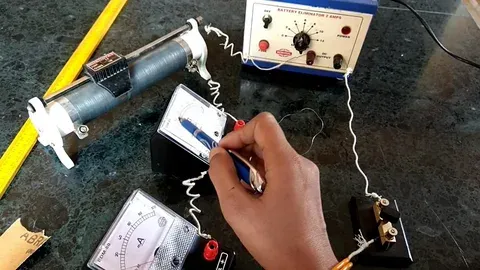
Galvanometer, ammeter, voltmeter, accumulator, resistance box, plug key, connecting wires, shunt wire, and screw gauge.
Theory
A galvanometer detects small currents. To measure larger currents, we connect a small shunt resistance (S) in parallel with it.
When current II flows, a part IgI_g passes through the galvanometer, and the remaining current (I−Ig)(I-I_g) moves through the shunt.
Thus, the galvanometer becomes an ammeter that measures higher currents safely.
S=G(IIg−1)S = \frac{G}{(\frac{I}{I_g} – 1)}
This equation shows that the value of the shunt depends on the galvanometer resistance GG and its current sensitivity IgI_g.
Procedure
1. Setup
First, connect the apparatus as shown in the circuit diagram. Next, keep key K2K_2 open and close key K1K_1. Then, adjust the resistance box until the galvanometer gives a large deflection.
2. Finding Galvanometer Resistance
After obtaining maximum deflection, close K2K_2. Adjust the shunt resistance SS until the galvanometer shows half of the previous deflection.
At this point, the galvanometer resistance GG equals the shunt resistance SS.
3. Determining Full-Scale Current
Now, measure the EMF of the battery using the voltmeter. Then, reconnect the shunt and note the current needed to give full-scale deflection. Consequently, this value gives the full-scale current IgI_g.
4. Preparing the Shunt Wire
Next, calculate the required resistance SS using the formula. Find the corresponding length of wire from the resistance table. Cut a slightly longer piece, mark the points, and attach the terminals properly.
5. Final Connection
Finally, connect the shunt wire parallel to the galvanometer. Pass current through the circuit and observe the reading. The galvanometer now works as an ammeter.
Observations and Calculations
| No.. of Obs. | Resistance R (ohms) | Deflection of the Galvanometer | Half Deflection (div) | Shunt resistance S (ohms) | Resistance of galvanometer |
|
| Observed (div) | Corrected 𝛉(div) | |||||
| 1 2 3 | ||||||
Mean galvanometer resistance: G=______ ΩG = \_\_\_\_\_\_ \, \Omega
EMF of the cell: E=______ voltsE = \_\_\_\_\_\_ \, \text{volts}
Full-scale current: Ig=______ AI_g = \_\_\_\_\_\_ \, \text{A}
Shunt resistance: S=______ ΩS = \_\_\_\_\_\_ \, \Omega
Results
The galvanometer was successfully converted into an ammeter with a maximum range of 1.5 A. The calculated shunt resistance allows safe measurement of higher currents.
Viva Questions
-
What does an ammeter measure?
→ It measures current in amperes. -
How is it connected in a circuit?
→ It connects in series. -
Why must it have low resistance?
→ To avoid changing the total current. -
How can we increase its range?
→ By using a smaller shunt resistance. -
Why can’t a DC ammeter measure AC?
→ Because the direction of AC changes continuously. -
What is the SI unit of current?
→ Ampere. -
What is an open circuit?
→ A circuit with a break or infinite resistance. -
What is a short circuit?
→ A path with very low resistance, allowing excessive current.