
Chinese scientists developed a mosquito-sized drone for military and medical use, capable of surveillance and controlled via smartphone with tiny wings.
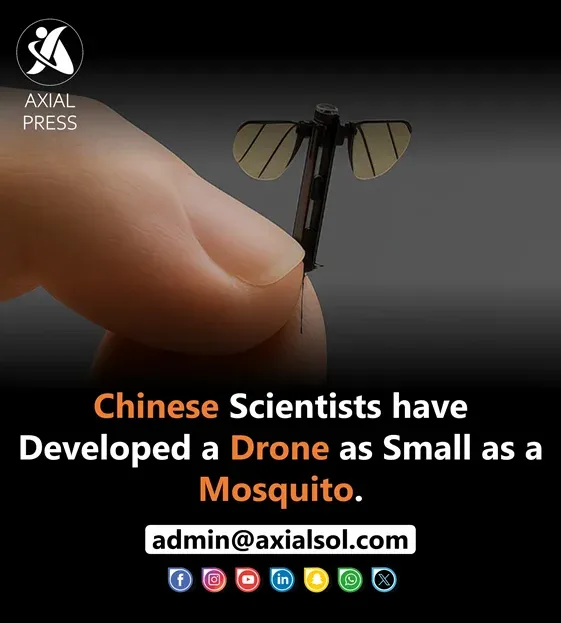
Tiny Mosquito-Sized Drone Developed by Chinese Scientists
Short summary
Chinese researchers have built a drone about the size of a mosquito. The team says the tiny robot can perform reconnaissance and special missions. They also see possible civilian uses.
Who made it and where it was shown
A robotics lab at the National University of Defense Technology (NUDT) in China developed the device. CCTV, China’s state broadcaster, aired a report about the drone. Later, Geo News covered the same story for viewers abroad.
What the researchers showed
In the TV segment, researcher Liang Hexiang held the drone in his hand. He said it is “about the size of a mosquito.” He added that such small robots can gather information and perform targeted tasks on a battlefield. The drone’s tiny wings look like leaves, he explained. Meanwhile, its thin legs help it land or perch.
How it works
According to the report, the prototype links to a smartphone for control. The team fitted sensors, a power source, and small control circuits into a tiny frame. This process was difficult. However, engineers solved many design and miniaturization challenges.
Military and civilian uses
First, the military could use these drones to scout areas silently. Second, they could support rescue teams in dangerous zones. Third, medical researchers might adapt the design for delivering small, urgent supplies. Thus, the device has both military and peaceful applications.
Technical and ethical challenges
Despite progress, the drone faces limits. For example, battery life remains short. Also, carrying heavy sensors reduces flight time. In addition, many ethical questions arise. Who will control swarms of such robots? Moreover, how will privacy and safety be protected? Experts say regulations must follow the technology.
Why this matters
This development shows rapid advances in robotics and miniaturization. Consequently, it could change how intelligence missions and emergency responses work. At the same time, it raises important policy issues. Therefore, governments, scientists, and the public must talk about rules and safeguards.