
To observe how the resistance of a thermistor changes with temperature using a voltmeter, ammeter, thermometer, and a heating setup.
Apparatus
Thermistor, beaker, tripod stand, boiling tube with paraffin, spirit lamp, thermometer, voltmeter, ammeter, power supply, and connecting wires.
Theory
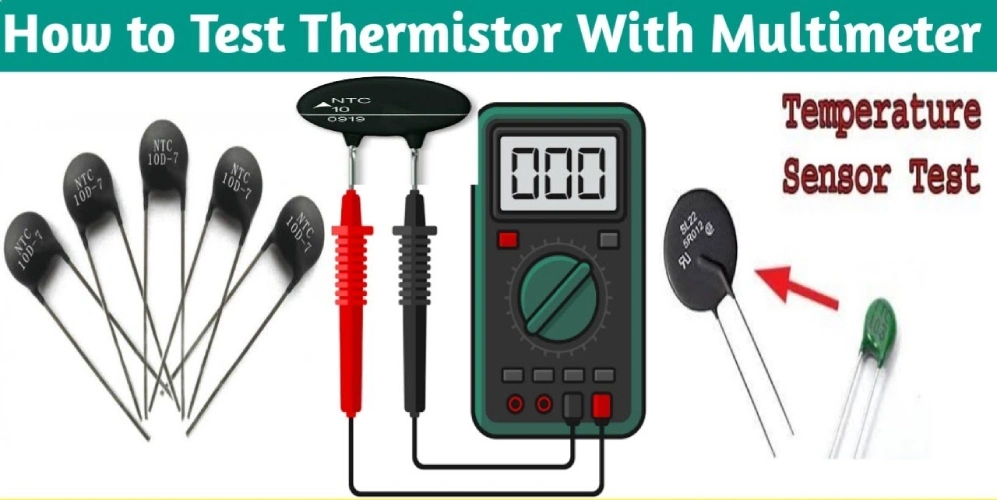
A thermistor is a semiconductor that changes its resistance with temperature. It has a negative temperature coefficient, meaning that resistance decreases as temperature increases. This property helps thermistors act as temperature sensors. They are often used in circuits that detect or control heat.
Procedure
-
First, draw the circuit diagram.
-
Connect the ammeter and power supply in series with the thermistor.
-
Connect the voltmeter in parallel to the thermistor.
-
Fix the thermometer beside the thermistor. Dip both into a boiling tube filled with liquid paraffin.
-
Place the boiling tube in a beaker that is two-thirds filled with water.
-
Switch on the power supply and note the readings of voltage, current, and temperature.
-
Gradually heat the water with a spirit lamp.
-
Record the readings after every 5°C rise in temperature.
-
Calculate resistance using the formula R = V / I for each step.
Observations and Calculations
Prepare a table with columns for temperature (°C), voltage (V), current (I), and calculated resistance (R).

Result
As the temperature increases, the resistance of the thermistor decreases. Hence, the thermistor follows a negative temperature coefficient.
Precautions
-
Keep the thermistor away from the walls of the boiling tube.
-
Use a sensitive thermometer for accurate readings.
-
Do not heat the liquid above 70°C.
Viva Voce
Q1: What is a thermistor?
Ans: It is a semiconductor device whose resistance changes with temperature.
Q2: What does a negative temperature coefficient mean?
Ans: It means resistance falls when the temperature rises.
Q3: What are thermistors used for?
Ans: They are used as temperature sensors and in fire alarms.
Q4: What is the SI unit of the temperature coefficient?
Ans: Its unit is per Kelvin (K⁻¹).
Q5: How does thermistor resistance vary with temperature?
Ans: Resistance decreases as temperature increases.