
Determine unknown wire resistance using a slide wire bridge via the Wheatstone principle, ensuring an accurate balance point and measurements.
Apparatus
-
Slide wire bridge
-
Resistance box
-
Unknown resistance
-
Galvanometer
-
Rheostat
-
Cell
-
Tapping key
-
Connecting wires and sandpaper
Theory
Wheatstone Bridge Principle
We determine unknown resistance using the Wheatstone bridge principle. A bridge consists of four resistances, P, Q, R, XP, Q, R, X, arranged in a network ABCDABCD. A galvanometer GG connects points BB and DD, while a cell connects points AA and CC (Fig. 1a).
When the bridge is balanced, points BB and DD have the same potential. Consequently, no current flows through the galvanometer. In this condition:
PQ=RX\frac{P}{Q} = \frac{R}{X}
Knowing three resistances, we can determine the fourth (XX).
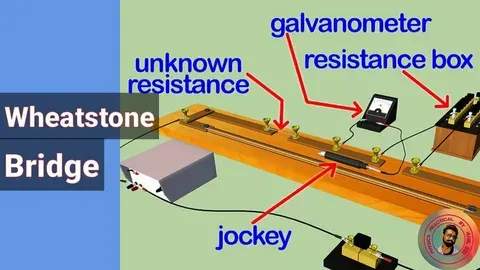
Slide Wire Bridge Setup
A slide wire bridge is a practical application of the Wheatstone bridge. It uses a uniform wire (constantan or manganin) of about one meter, stretched on a wooden board between terminals AA and CC (Fig. 1a).
Wire Terminals and Gaps:
A copper strip with terminals N, O, TN, O, T forms gaps M−TM-T. A cell connects between DD and a sliding jockey. The jockey touches any point along the wire.
Balance Point Determination:
Insert a resistance RR using a resistance box. Adjust the jockey until the galvanometer shows no deflection. This position is called the balance or null point, measured from both ends, AA and CC.
Resistance Calculation:
Since the wire’s resistance is proportional to its length:
X=Rl1l2X = R \frac{l_1}{l_2}
where l1l_1 and l2l_2 are distances from AA and CC to the balance point.
Procedure
Step 1: Circuit Setup
-
Draw a circuit diagram (Fig. 1a).
-
Clean wire ends with sandpaper.
-
Connect the galvanometer GG, resistance box R.BR.B, unknown resistance XX, and tapping key KK.
Step 2: Testing Connections
-
Close the key to test the circuit.
-
Place the jockey in the middle of the wire and observe the galvanometer deflection.
-
Then, remove plugs one by one to check the correct connection.
Step 3: Finding Balance Point
-
Slide the jockey to locate the balance point between 40–60 cm.
-
Measure distances from AA and CC.
Step 4: Repetition
-
Repeat the experiment with different values of RR.
-
Calculate X=Rl1l2X = R \frac{l_1}{l_2} for each observation.
-
Compute the mean value of XX.
Observations & Calculations
| No of obs. | Resistance applied by resistance box R (ohms) | Distance of the balance point B from the end point A |
Distance of the balance point B from the end point C. |
Unknown resistance X=Rx |
| 1 2 3 |
.. .. .. | .. .. .. | .. .. .. | .. .. .. |
Mean resistance of wire =X=——————- (ohms)
Precautions
-
Keep connections clean, neat, and tight.
-
Shunt the galvanometer to prevent damage.
-
Turn off the current after each observation to maintain wire temperature.
-
Close the battery key first, then complete the galvanometer circuit.
-
Keep the balance point near the wire center for maximum sensitivity.
-
Avoid pressing the jockey too hard.
-
Ensure all resistance box plugs are firmly pressed.
Viva Questions and Answers
Q1. What is the condition for balancing a Wheatstone bridge?
A1. The potential difference across the galvanometer should be zero.
Q2. Does the null point indicate no current or equal opposite currents?
A2. It indicates no current.
Q3. What is the advantage of the null method?
A3. Detecting zero deflection is easier than measuring a deflection accurately.
Q4. What is a shunt?
A4. A shunt is a low-resistance wire connected across the galvanometer. It diverts most current and protects the galvanometer.
Q5. Why should connections be clean?
A5. Dust and grease increase resistance, reducing accuracy.
Q6. Define electric current.
A6. Current is the rate of flow of electric charge.
Q7. What is the unit of current?
A7. One ampere passes 1 coulomb of charge per second through a cross-section.
Q8. What is resistance?
A8. Resistance opposes current flow. Unit: ohm.
Q9. Define one ohm.
A9. One ohm allows 1 A current under 1 V potential difference.
Q10. How does temperature affect resistance?
A10. Resistance rises as collisions of electrons with atoms increase with temperature.
Q11. State Ohm’s law.
A11. Current is proportional to potential difference if the conductor’s physical state does not change.
Q12. On which factors does resistance depend?
A12. Material, dimensions, and temperature.
Q13. What is conductance?
A13. Conductance is the reciprocal of resistance; unit: siemens (S).
Q14. Equivalent resistance:
-
Series: Req=R1+R2+…R_\text{eq} = R_1 + R_2 + \dots
-
Parallel: 1Req=1R1+1R2+…\frac{1}{R_\text{eq}} = \frac{1}{R_1} + \frac{1}{R_2} + \dots
Q15. Define specific resistance.
A15. Resistivity is the resistance of 1 m³ of a material; unit: ohm-meter.
Q16. Define conductivity.
A16. Conductivity is the reciprocal of resistivity; unit: (Ω-m)−1(\Omega\text{-m})^{-1}.
Q17. What is Eureka wire?
A17. An alloy of 40% nickel and 60% copper.
Q18. Why is it called a slide wire bridge?
A18. A jockey slides along the wire to find the balance point.
Q19. Principle of the Wheatstone bridge?
A19. Four resistances balance when no current flows through the galvanometer.
Q20. How is unknown resistance determined?
A20. Using the ratio of wire lengths: X=Rl1l2X = R \frac{l_1}{l_2}.
Q21. What does zero deflection indicate?
A21. No current passes through the galvanometer.
Q22. Why should the balance point lie between 40–60 cm?
A22. To keep the ratio of arms nearly equal, increasing sensitivity.
Q23. Why maintain clean, tight connections?
A23. Loose or dirty connections add resistance and reduce accuracy.
Q24. Does wire thickness affect specific resistance?
A24. No, it depends only on material and temperature.