
Resonance tube experiment to determine the wavelength of sound and calculate its speed, considering end correction and the influence of temperature.
Apparatus
-
Resonance tube apparatus
-
Two tuning forks of known frequency
-
Plumb line
-
Vernier calipers
-
Rubber pad
-
Thermometer
-
Set of squares
-
Pinch cork
-
Beaker
Observations
-
Vernier Constant of Caliper: 0.01 cm
-
Zero Correction of Caliper: ……… cm
-
Internal Diameter of Resonance Tube:
-
(i) … cm
-
(ii) … cm
-
(iii) … cm
-
-
Mean Corrected Diameter (D): … cm
-
End Correction: 0.3 D = … cm
-
Room Temperature at Start: t₁ °C
-
Room Temperature at End: t₂ °C
-
Mean Room Temperature: t = (t₁ + t₂)/2 = … °C
-
Position of Open End of Tube (X): … cm
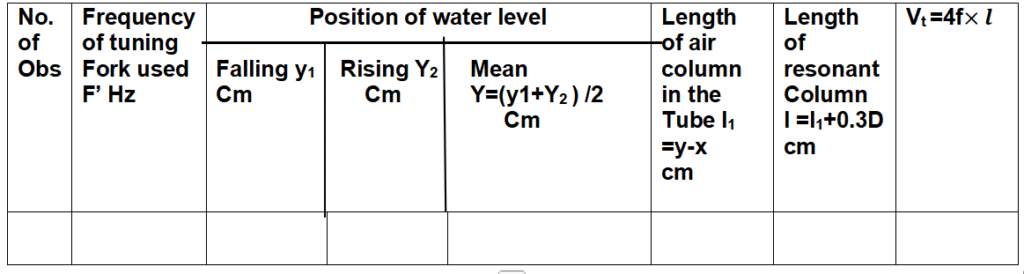
Calculation:
Velocity of sound in air at 00C =V0 =V1 -6It =……………..cm/sec.
Actual value of velocity of sound at 00C =………cm / sec.
Difference =………..cm /sec.

=………………%
Procedure
-
Place the apparatus on a smooth, horizontal surface and check the level using a plumb line. Adjust the apparatus with foot screws if necessary.
-
Determine the vernier constant of the caliper and check its zero error.
-
Measure the internal diameter of the resonance tube at multiple points and calculate its mean diameter. Apply zero correction.
-
Note the initial water temperature (t₁ °C) with a thermometer. Record the position of the upper end of the resonance tube as X.
-
Raise the water reservoir to its highest level, then open the pinch cock.
-
Gently strike a tuning fork of known frequency (e.g., 512 Hz) on the rubber pad and hold it horizontally above the open end of the tube.
-
Gradually lower the water level until resonance occurs with a loud note. Record the resonance position using set squares.
-
Repeat the procedure when the water level is rising, and note this position. Take the mean value as Y.
-
Calculate t = Y – X. Record the final temperature (t₂ °C).
-
Repeat the experiment with the second tuning fork.
-
Finally, calculate the velocity of sound at 0°C using the observed data and corrections.
Calculations
-
Velocity of Sound at 0°C: V₀ = V₁ – 0.61t … cm/sec
-
Actual Velocity at 0°C: … cm/sec
-
Difference: … cm/sec = … %
Precautions
-
Strike the tuning fork gently on the rubber pad.
-
Keep the resonance tube vertical.
-
Ensure the prongs of the tuning fork do not touch the tube.
-
Hold the vibrating tuning fork horizontally above the open end.
-
Read the low meniscus of water using two set squares.
Viva-Voce
Q1. What is meant by resonance?
Ans: Resonance occurs when a small periodic force acts on a body whose natural period matches that of the force, causing large-amplitude vibrations.
Q2. What is end correction?
Ans: The antinode does not lie exactly at the open end but slightly above it. This shift, called end correction, is approximately 0.3 D, where D is the internal diameter of the tube.
Q3. What is the effect of temperature on the velocity of sound?
Ans: The velocity of sound increases by approximately 61 cm/sec for every 1°C rise in temperature.
Q4. Define node and antinode.
Ans:
-
Node: A point where the strain is maximum and the amplitude is zero.
-
Antinode: A point where the strain is minimum and the amplitude is maximum.