
Determine the volume of a cylinder using Vernier calipers by measuring its diameter and length accurately and applying the formula V = πr²l.
Apparatus
Vernier callipers and a solid cylinder.
Diagram
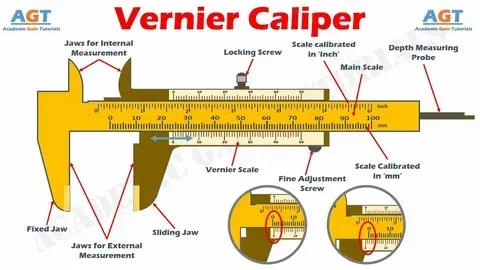
Vernier Callipers
Introduction
Vernier callipers are used to measure the length, internal, and external diameters of objects with high accuracy.
They consist of a rectangular steel bar graduated in inches on one edge and in centimeters on the other. This is known as the main scale. Over this main scale slides a smaller scale called the Vernier scale, which improves precision.
Parts and Function
There are two jaws — upper and lower.
-
The upper jaws measure the external diameter of rods or tubes.
-
A thin rectangular rod attached at the back helps measure the depth of vessels.
Thus, Vernier callipers allow precise measurement of length, diameter, and depth.
Vernier Constant
The difference between one main scale division and one Vernier scale division is called the Vernier constant or least count.
Usually, when both jaws are adjusted, the zero of the main scale coincides with the zero of the Vernier scale — meaning no error.
If this alignment is off, the instrument has a zero error, which can be either positive or negative.
Zero Error
1. Positive Error
If the zero mark of the Vernier scale lies ahead of the main scale’s zero mark, the error is positive.
To find it:
-
Note the Vernier division coinciding with any main scale division.
-
Multiply that number by the least count.
For example, if the 4th division coincides:
Zero error = +4 × L.C. = +4 × 0.01 cm = +0.04 cm
Zero correction = –0.04 cm
2. Negative Error
If the zero mark of the Vernier scale lies behind the main scale’s zero, the error is negative.
To find it:
-
Identify the coinciding Vernier division.
-
Subtract that number from 10.
-
Multiply the result by the least count.
For example:
Zero error = –(10 – 4) × L.C. = –6 × 0.01 cm = –0.06 cm
Zero correction = +0.06 cm
Procedure
-
First, find the least count (Vernier constant) and zero error.
-
Next, place the given cylinder lengthwise between the lower jaws of the callipers.
-
Tighten the jaws so that the cylinder is held firmly.
-
Observe the main scale reading just to the left of the Vernier zero.
-
Then, note which Vernier division coincides with a main scale mark.
-
Multiply that division by the least count and add it to the main scale reading.
→ This gives the length of the cylinder. -
Similarly, measure the diameter and calculate the radius (r).
-
Finally, find the volume using the formula:
V=πr2lV = \pi r^2 l